How to Identify Australian Lorikeets: A Guide to Rainbow, Scaly-breasted & More
Introduction: A Flash of Confusing Colour
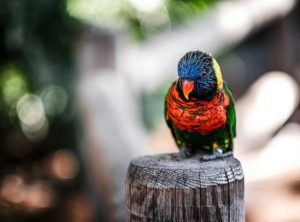 You see a flash of green, blue, and red darting through the trees—it’s unmistakably a lorikeet. But Australia is home to several stunning lorikeet species, and telling them apart can be tricky. Whether you’re a budding birdwatcher or just curious about your noisy garden visitors, this visual guide will help you confidently identify the most common Australian lorikeets.
Part 1: The Quick-Reference Identification Table
Use this table to compare key features at a glance. The most common confusion is between the Rainbow Lorikeet and the Scaly-breasted Lorikeet.
| Feature | Rainbow Lorikeet | Scaly-breasted Lorikeet | Musk Lorikeet | Little Lorikeet |
|---|---|---|---|---|
| Primary Colour | Bright green with a deep blue head. | Uniform bright green overall. | Deep green with a red forehead. | Bright green with a red face mask. |
| Chest & Belly | Vibrant orange/yellow “rainbow” barring. | Yellow scalloping or “scales” on green. | Yellow patch under the wing in flight. | Red patch under the throat. |
| Size | Medium (approx. 30cm). | Medium (approx. 30cm). | Small (approx. 22cm). | Very small (approx. 19cm). |
| Key Identifier | Blue head + orange/yellow barred chest. | All green with yellow scallops (no blue head). | Red forehead patch; smaller and quieter. | Tiny size; fast, darting flight; red face. |
| Common Range | Coastal eastern & northern Australia. | Eastern Australia, often with Rainbows. | South-eastern Australia & Tasmania. | Eastern and south-eastern Australia. |
Part 2: Detailed Spotting Guide (With Visual Cues)
1. The Classic: Rainbow Lorikeet (Trichoglossus moluccanus)
-
Look for: The bright blue head and nape is the dead giveaway. From the front, you’ll see the striking orange
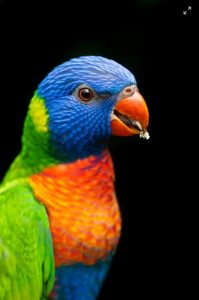 and yellow barred pattern on the chest.
 -
Behaviour: Highly social, extremely noisy, and often in large, squabbling flocks.
-
Tip: If it has a blue head, it’s a Rainbow. No exceptions in mainland Australia.
2. The Lookalike: Scaly-breasted Lorikeet (Trichoglossus chlorolepidotus)
-
Look for: No blue on the head. Instead, look closely at the chest and belly for distinct yellow “scales” or scallops on a green background.
-
Behaviour: Often mixes with Rainbow Lorikeet flocks. Their call is slightly harsher and more grating.
-
Tip: The all-green body with yellow scallops is unique. Remember: No blue head = not a Rainbow.
3. The Lesser-Known: Musk and Little Lorikeets
-
Musk Lorikeet: Look for a crimson red forehead and stripe over the eye against a deep green body. Smaller and often slightly less raucous.
-
Little Lorikeet: Tiny and fast. The key mark is a red facial mask extending from the forehead to just below the eyes. They can be easy to miss in the canopy.
Part 3: Why Correct Identification Matters
Knowing which lorikeet you’re watching enhances your birding experience and is useful for:
-
Citizen Science: Accurate logging in apps like Birdata or eBird.
-
Garden Planning: Understanding which local species your native plants might attract.
-
Conservation: Being aware of the species diversity in your local area.
Test Your Knowledge
 Next time a flock descends, take a moment. Look for the blue head or the yellow scallops. With this guide, you’ll move from “just a lorikeet” to a confident identifier.
Still unsure or spotted something different? Describe the bird in the comments below—our community can help!
Dive deeper into their world in our main guide, attract them to your garden and Everything About Australian Lorikeets.