A Classic Case of Mistaken Identity
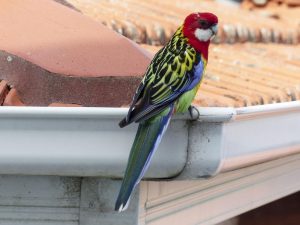
The flash of red, green, and blue in your garden could be one of two stunning parrots: the Crimson Rosella or the Eastern Rosella. While both are iconic, mixing them up is a common rite of passage for birdwatchers. This guide cuts through the confusion with a direct, feature-by-feature comparison, so you can make a confident identification in seconds.
Part 1: The Head-to-Head Comparison Table
When time is short, this table is your quick-reference cheat sheet.
| Identification Feature | Crimson Rosella | Eastern Rosella |
|---|---|---|
| Head Colour | Deep, uniform crimson red with brilliant violet-blue cheek patches. | Tricolor pattern: Red forehead and throat, bright white cheeks, fading to green on the nape. |
| Chest & Belly | Rich, uniform crimson red (or rich orange/yellow in the ‘Yellow’ subspecies). | Vibrant, sunflower yellow. A stunning contrast against the red head. |
| Back & Wings | Black feathers with broad, crimson red edges, creating a strong scalloped appearance. | Black back with distinct, large patches of green and bright blue on the wings. |
| Tail & Underparts | Blue tail with red undertail coverts. | Blue-green tail with predominantly green underparts. |
| Key Identifier | “All-over red” body with blue cheeks. | “Red, white, and yellow” colour block pattern. |
| Call | A pleasant, melodic, double-note whistle: “pee-pipe” or “cussik-cussik”. | A sharper, more rapid, chirping “pi-di-pi-di” or “chit-chit-chit”. |
Part 2: The Foolproof Three-Step ID Check
Follow these steps in order the next time you see a rosella.
Step 1: Look at the HEAD.
-
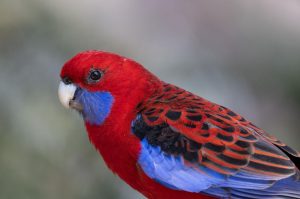
A Crimson Rosella Solid Crimson Red + Blue Cheeks? → You’re looking at a Crimson Rosella. Stop here. You’ve solved it.
-
Red Forehead + Crisp White Cheeks? → You’re looking at an Eastern Rosella. Proceed to Step 2 to confirm.
Step 2: Look at the CHEST.
-
Is the chest a brilliant, clear yellow? → Confirmed: Eastern Rosella. The yellow is unmistakable.
-
*(If the chest is red, you’ve mis-identified the head in Step 1—it’s a Crimson).*
Step 3: Listen and Observe (Bonus Confirmation)
-
Habitat: Easterns are more common in open woodlands, farmland, and suburban parks, often feeding on the ground. Crimsons favour denser forests and wetter woodlands, but often visit gardens.
-
Behaviour: Both can be seen in pairs or small flocks. Easterns often appear slightly more agile and rapid in movement.
Part 3: Special Cases & Subspecies
The “Yellow Rosella” – Don’t Let It Fool You!
Along the Murray River system, you might see a Crimson Rosella that is mostly yellow and orange. This is the ‘Yellow’ subspecies (Platycercus elegans flaveolus). The key is the pattern: it retains the blue cheek patches and the scalloped wing pattern of the Crimson, just in yellow instead of red. It does not have the Eastern’s white cheeks and yellow chest.
The Adelaide Rosella is an intermediate orange hybrid between the Crimson and Yellow subspecies in South Australia.
Part 4: Quick Tips for Photographers & Birders
-
The Cheek Patch is King: The presence of blue cheek patches almost always indicates a Crimson (or its Yellow variant). Easterns have white cheeks.
-
The Chest Never Lies: A red chest = Crimson. A yellow chest = Eastern.
-
Lighting Matters: In poor light, the Eastern’s yellow chest can look pale, but the white cheek patches will still be visible.
- Attract Rosellas to Your Garden: Ethical Food Tips
- Rosella Calls & Sounds: Decoding Their Melodious Chirps
- Rosella Seasonal Movement: Do They Migrate or Stay Put?
- What do Rosellas Eat in The Wild?
- Australian Bird ID Guide
From Confusion to Clarity
The difference is stark once you know what to look for: the Crimson Rosella is a masterpiece in shades of red and blue, while the Eastern Rosella is a bold artist’s palette of red, white, and yellow.
Remember the mantra: “Red and blue cheeks? Crimson for sure. White cheeks and yellow chest? Eastern is your guest.”
Still unsure? Compare your sighting with our full gallery in the Complete Guide to Australian Rosellas.
Think you’ve mastered it? See our Rosella vs Lorikeet article. Test your skills in the comments by describing a rosella you’ve seen!